KFC Halal Status in Canada | Is KFC Halal or Haram in Canada?
Muslim customers in Canada ask this question a lot: is KFC halal, or is it haram? It sounds like a simple yes-or-no question.
Here is the short answer you can save right now: KFC Canada is not fully halal across the whole country, and it is not fully haram either. The answer changes by province, by city, and sometimes by the exact restaurant you walk into. A KFC in Brampton might serve halal-certified chicken. A KFC two hours away might not.
This guide breaks down what “halal” actually means, what changed at KFC Canada in the last two years, and how to check your nearest location before you order. We cover the current KFC Halal Status by province, the certificates you should ask to see, and honest answers for cities like Toronto, Mississauga, and Montreal.
What Makes Food Halal or Haram in Islam?
Before we get into KFC, it helps to know what these two words mean.
“Halal” is an Arabic word. It means something is allowed under Islamic law. “Haram” is the opposite. It means something is forbidden. Food, drinks, and even daily actions can be halal or haram.
For meat to count as halal, it usually needs to go through a specific process. That process is called zabiha (also spelled dhabihah).
The Halal Slaughter Requirement (Zabiha)
In zabiha slaughter, a Muslim performs the slaughter by hand. The animal must be alive and healthy at the time. The person says a blessing, usually “Bismillah” (in the name of God), right before the cut. A sharp knife is used to cut the throat in one motion, and the blood is fully drained from the body.
What Makes Meat Haram
Chicken can become haram in a few ways. Here are the main ones:
- The animal was not slaughtered by a Muslim, or the blessing was not said
- The animal was already dead, sick, or unconscious before slaughter
- The blood was not properly drained
- The meat touched pork, alcohol, or other haram substances during cooking or storage
- The animal was slaughtered using a method that skips the religious requirements
This last point matters a lot for fast food. A restaurant can buy 100% halal-certified raw chicken and still serve a haram meal, if that chicken is fried in the same oil as bacon or pork sausage. This is called cross-contact, and we will come back to it later in this guide.
Now that you know the basics, let’s look at what KFC Canada actually does.
What Changed in May 2024
Before 2024, halal availability at KFC Canada really did vary by franchise, the way it still does at some other fast food chains. Individual restaurant owners made their own sourcing decisions, so a KFC in one city might serve halal chicken while a KFC a few blocks away did not.
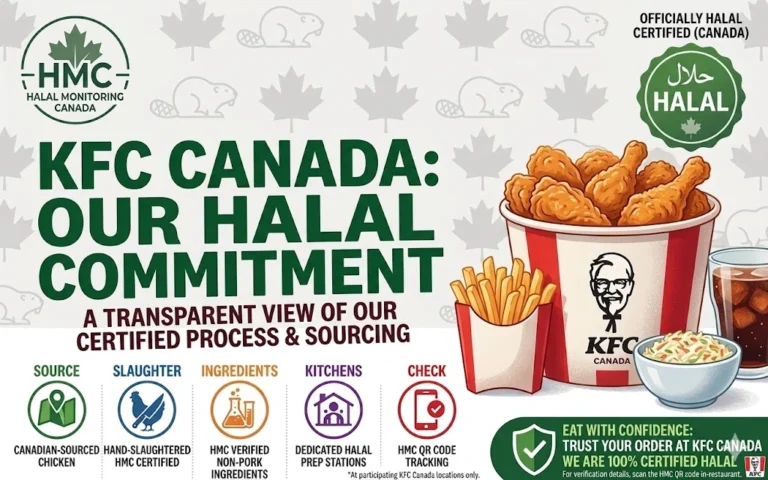
That changed with a company-wide announcement in 2024. KFC Canada moved its chicken supply to Maple Lodge Farms and its Zabiha Halal brand, one of the largest halal poultry suppliers in the country. The rollout covered the large majority of Canadian locations, and pork products came off the menu at the same time to keep the switch consistent, since pork and halal-certified meat can’t reasonably share a kitchen.
This was widely reported at the time, including by NOW Toronto, and it lines up with what KFC Canada has communicated directly.
Which Locations Are the Exception
Two situations still fall outside the standard halal rollout:
Taco Bell co-branded restaurants. Some KFC locations share a building and kitchen with Taco Bell. Because Taco Bell’s menu still includes items that don’t fit halal preparation standards, these combined locations are not part of the halal switch.
A small number of individual outlets. Reporting at the time of the rollout named a handful of locations, including some in Ottawa and Thunder Bay, as slower to transition because of local supplier logistics. If you live near one of these areas, it’s worth a quick call to your local restaurant to confirm current status, since supply arrangements can change.
Outside of those two situations, halal-certified chicken is now the standard across KFC Canada, not the exception.
A Note on Cross-Contact
Halal certification covers sourcing and preparation standards for the chicken itself. It does not mean a completely separate kitchen. Most KFC Canada locations use shared fryers, prep surfaces, and equipment across the menu.
For most customers this isn’t an issue. But if you follow halal dietary rules strictly and cross-contact matters to you, it’s worth asking your local restaurant directly how their kitchen is set up before you order. This is standard advice for any fast food kitchen, halal-certified or not, and it’s the same caution KFC Canada itself gives on allergen handling.
How to Confirm Before You Order
If you want certainty beyond what’s written here:
- Call your local restaurant. Staff can confirm current halal status and any kitchen-sharing setup on the spot.
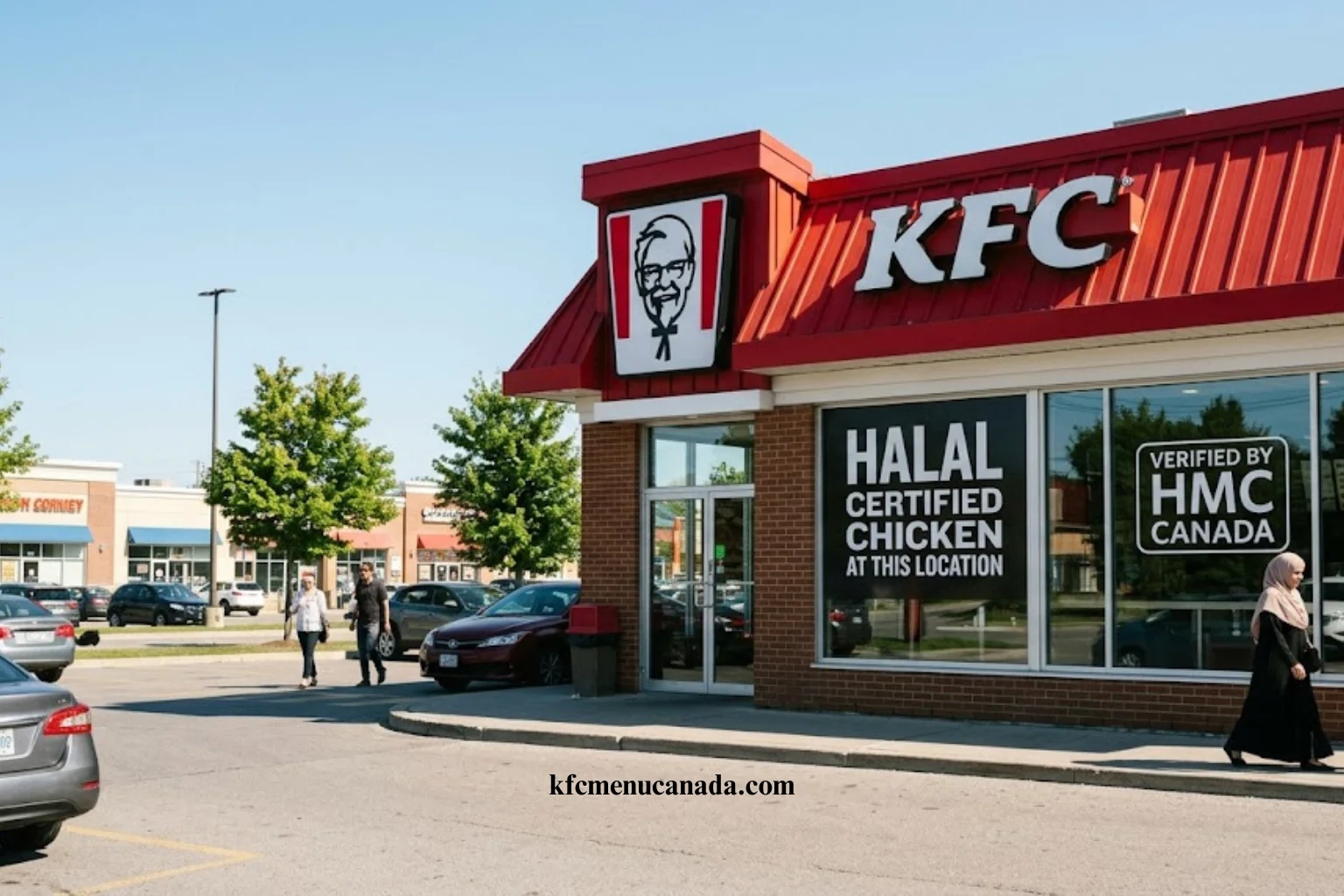
- Check for in-store signage. Halal-certified locations typically display certification signage near the counter or menu board.
- Ask about Taco Bell co-branding. If your nearest KFC shares a building with Taco Bell, ask specifically, since these locations are the main exception to the nationwide policy.
Is KFC Halal or Haram in Canada? The Direct Answer
There is no single, national “KFC Canada is halal” policy. KFC Canada runs on a franchise model. Each restaurant has its own owner, and that owner makes real decisions about which supplier to use and how the kitchen runs, inside KFC’s overall brand rules.
Here is what we know for sure, based on public reporting from 2024:
In May 2024, KFC Canada sent a memo to community leaders and franchise owners in Ontario. The memo said that most Ontario locations would start serving halal-certified chicken, sourced through Maple Lodge Farms and its Zabiha Halal brand. At the same time, most Ontario stores stopped selling pork products like bacon. CBC News and several trade publications, including Canadian Poultry Magazine and Poultry World, reported on this shift in July 2024, after it became public.
Two exceptions were named at the time: Thunder Bay and Ottawa. Locations that share a building with Taco Bell were also allowed to keep pork products, since Taco Bell menus include some pork items.
That was 2024. As of 2026, KFC Canada still has not announced a single, company-wide halal certification that covers every province and every store. So the honest, current answer is this: your closest KFC might be halal. It might not be. You have to check.
KFC Halal Status by Province
| Province | Halal Status | Notes |
|---|---|---|
| Ontario | Most locations use halal-certified chicken | Thunder Bay and Ottawa were named exceptions in 2024; Taco Bell combo stores may still carry pork items |
| Alberta | Depends on the location | Some Calgary and Edmonton area stores use halal suppliers, based on local franchise choice |
| British Columbia | Depends on the location | Cities with larger Muslim communities, such as Surrey and Abbotsford, are more likely to carry halal chicken |
| Quebec | Not common | Halal-certified KFC locations are rare; always confirm before you visit |
This table is a general guide, not a guarantee. Franchise owners can change suppliers. A store that was halal last year might not be halal today, and the other way around too.
When Did KFC Become Halal in Canada?
The change did not happen overnight, and it did not happen everywhere at once.
KFC Canada’s shift toward halal-certified chicken in Ontario started around May 2024. The company worked with Maple Lodge Farms, a major Canadian poultry supplier that owns the Zabiha Halal brand. This partnership meant most Ontario restaurants could serve halal chicken across their whole chicken lineup, including chicken on the bone, tenders, popcorn chicken, wings, and sandwiches.
Why the Change Happened?
A few things pushed this decision. Canada’s Muslim population has grown steadily. Statistics Canada figures from recent census data show Ontario is home to a large share of that population, especially in cities like Toronto, Mississauga, and Brampton.
KFC also had competition to think about. Popeyes and Mary Brown’s, two other big chicken chains in Canada, already offered halal chicken at many locations. CBC News reported that KFC’s Ontario move put it in line with what those competitors were already doing.
It is worth being clear about one thing: this Ontario shift was never described by KFC as a full national halal certification. It was a regional supply change, mostly limited to Ontario, with named exceptions even inside that province. Coverage of the announcement also noted public pushback, with some customers criticizing the change online and others supporting it. That reaction is part of the public record, but it does not change what actually happened on the ground: most Ontario stores switched suppliers, and most other provinces were left up to individual franchise choice.
Is KFC 100% Halal in Canada?
No. Not even in Ontario, where the biggest change happened.
Why “100%” Is the Wrong Question
“100% halal” is a high bar. It does not just mean the raw chicken came from a halal-certified farm. It means every single thing that touches your food, from the fryer oil to the prep counter to the person cooking it, follows halal rules the whole way through. Very few fast food chains anywhere in the world can promise that for every single item on the menu, at every single location.
The Cross-Contact Factor
Even at a KFC location that buys halal-certified chicken, a few things can still cause problems for a strict halal diet:
- Shared fryers, if any non-halal item is cooked in the same oil
- Shared prep surfaces or utensils used for both chicken and other proteins
- Sauces, gravies, and coleslaw dressings, which are made in central kitchens and may not carry halal certification themselves
- Seasoning blends and marinades that come from suppliers who also handle non-halal ingredients
Halal-certified chicken tells you about the animal and the slaughter process. It does not automatically tell you about everything else that happens in the kitchen after that chicken arrives at the restaurant.
What “Halal-Certified Chicken” Covers vs. Does not Cover
| Usually covered | Usually needs separate checking |
|---|---|
| The chicken itself (raw meat, slaughter method) | Sauces, gravies, and dips |
| Main chicken products (tenders, wings, on-the-bone) | Sides like coleslaw or desserts |
| Supplier certification (for example, Zabiha Halal) | Shared fryer oil with non-halal items |
| — | Cross-contact during busy kitchen prep |
If any of this matters to you, the safest move is always to ask the store directly, not to guess from a general policy.
Can Muslims Eat KFC in Canada?
This is a personal choice, and there is no single right answer for every Muslim customer. People approach it in different ways, based on how strict they want to be about halal food. Here are three common approaches Muslim customers in Canada actually use:
- Only order at confirmed-certified locations. These customers call ahead, ask for the certifying body’s name, and only eat at stores that can show proof.
- Accept some cross-contact as tolerable. Some customers are comfortable with halal-certified chicken even if sauces or fryers are shared, based on their own understanding of Islamic dietary rules.
- Avoid KFC entirely until it is confirmed. Other customers skip it completely unless a specific location is verified as halal, choosing to wait rather than guess.
This guide is not a religious ruling, and it is not trying to tell you which approach is correct. It is meant to give you facts so you can make your own informed decision, ideally with guidance from your local mosque or imam if you want a religious opinion on cross-contact and shared equipment.
Is KFC Halal in Major Canadian Cities?
Is KFC Halal in Toronto?
Toronto sits inside Ontario’s broader 2024 shift, so many Toronto-area KFC locations carry halal-certified chicken. Toronto was not named as an exception city in the original 2024 memo. Even so, call your specific location before you go, since ownership and suppliers can differ store to store within the city.
Is KFC Halal in Mississauga?
Mississauga has one of the largest Muslim populations in the Greater Toronto Area. Several KFC locations here are reported to carry halal-certified chicken as part of the wider Ontario rollout. Confirm with the exact store, since Mississauga has many KFC locations under different franchise owners.
Is KFC Halal in Ontario?
At a province-wide level, most Ontario KFC stores moved to halal-certified chicken starting in 2024, with Thunder Bay and Ottawa named as exceptions and Taco Bell combo locations allowed to keep pork items. For a full breakdown of nearby stores, check our [KFC Outlet Locator].
Is KFC Halal in Montreal?
Quebec was not part of the 2024 Ontario announcement. Halal-certified KFC locations in Montreal are not common, and there is no public record of a province-wide halal supply change in Quebec. If halal certification matters to you, call ahead before visiting a Montreal-area store.
Is KFC Halal in Quebec?
The same applies province-wide. Quebec has not seen the kind of broad halal rollout that Ontario saw in 2024. Some individual franchise owners may still choose halal suppliers on their own, so it is worth checking rather than assuming either way.
KFC Halal Certificate — What It Is and How to Verify One
A halal certificate is a document from a recognized certifying body. It proves that a supplier or restaurant follows halal rules for a specific product or process.
Who Issues Halal Certificates in Canada
A few organizations handle most halal certification work in Canada:
- Islamic Food and Nutrition Council of Canada (IFANCC) — one of Canada’s longest-running halal certifiers, working across food, and other industries
- Halal Monitoring Authority (HMA Canada) — founded in 2004, focused heavily on meat and poultry, with on-site inspections and ongoing monitoring
- ISNA Canada Halal Certification Agency — connected to the Islamic Society of North America
- Canadian Halal Food Certifying Agency (CHFCA) — combines halal compliance checks with food safety standards like HACCP
Maple Lodge Farms, the supplier named in KFC’s 2024 Ontario memo, uses the Zabiha Halal brand for its halal-certified poultry.
What a Legitimate KFC Halal Certificate Canada Should Show
If a store shows you a certificate, or tells you about one over the phone, a real one should include:
- The name of the certifying body (for example, HMA Canada or IFANCC)
- An expiry or issue date, since certificates are not permanent
- The supplier’s name (for example, Maple Lodge Farms / Zabiha Halal)
- Some way to confirm it, either displayed in-store or available on request from a manager
If a staff member cannot name a certifying body or a supplier, treat that as a sign to keep checking rather than a confirmed yes.
How to Check Which KFC Is Halal Near You?
Guides and general province tables only get you so far. For an exact answer about the store you plan to visit, do this:
- Call ahead and ask direct questions. Ask if the chicken is halal-certified, and which supplier they use.
- Ask about fryer-sharing. Find out if chicken is cooked in oil shared with any non-halal item.
- Request to see the certificate. A manager should be able to show you one, or tell you where it is posted.
- Check community halal directories. Sites like Zabihah.com and apps like IslamicFinder sometimes list user-reported halal fast food spots, though these listings depend on people submitting updates, so treat them as a starting point, not a guarantee.
- Combine store locator tools with local knowledge. Use our [KFC Outlet Locator] to find the nearest stores, then cross-reference with your local mosque or community group, since local community members often know which stores changed suppliers first.
Sample Questions to Ask Staff
- “Is your chicken halal-certified, and who is the supplier?”
- “Is the fryer oil shared with any pork or non-halal products?”
- “Do you have a halal certificate I can see?”
- “Has this changed recently, or has it been the same for a while?”
A lot of people search “kfc halal near me” and expect an app or map to give a final answer. Store locators are great for finding the closest address, but they cannot confirm halal status on their own. Only a phone call or a certificate check can do that.
KFC Canada Nutrition, Ingredients & Allergen Info
Beyond the slaughter method, some customers also want to know what is actually inside their meal, since ingredients can matter for both halal and allergen reasons.
Reading the Full Ingredients List
KFC Canada publishes ingredient and allergen documents through KFC.ca, and this information is also available through the KFC Canada app or from a restaurant manager. These lists cover things like breading ingredients, sauce components, and shared cooking equipment notes. Because recipes and suppliers can change, KFC updates these documents from time to time, so it is worth checking the current version on KFC.ca rather than relying on an old printout.
What to Double-Check in Sauces and Sides
Sauces, gravies, and desserts are made separately from the chicken itself, and they do not automatically carry the same halal status as halal-certified meat. If a specific sauce or side matters to your diet, ask to see the current ingredient sheet for that item rather than assuming it matches the chicken’s status.
For general nutrition numbers on popular items, our [KFC Canada Nutrition] page breaks down calories and allergens across the current menu.
KFC Halal Status vs. Other Fast Food Chains in Canada
KFC is not the only chicken chain dealing with this question. Here is a quick, honest comparison based on public reporting:
| Chain | Halal Availability in Canada |
|---|---|
| KFC Canada | Most Ontario locations (2024 shift); other provinces depend on the franchise |
| Popeyes Canada | Halal chicken at a number of locations, mostly in areas with larger Muslim populations |
| Mary Brown’s | Halal chicken at select locations, varying by store and region |
Across all three chains, the same rule applies: check the specific location, since halal availability is rarely guaranteed company-wide.
Frequently Asked Questions (FAQs)
Conclusion
KFC Canada is neither fully halal nor fully haram as a company. Most Ontario locations moved to halal-certified chicken starting in 2024, with a few named exceptions. Other provinces depend entirely on what each individual franchise owner chooses to do.
The safest habit is a simple one: before you order, call the store and ask. Confirm the supplier, ask about shared fryers, and request to see a certificate if one is available. Community halal directories and store locators can point you in the right direction, but a direct answer from the restaurant is always the most reliable one.
We update this guide regularly from Toronto, based on public reporting and franchise-level details across Ontario, Alberta, British Columbia, and Quebec. If you spot a change at your local KFC, that kind of on-the-ground update is exactly what keeps this guide accurate for the next person searching the same question.
For more on what is actually on the menu, see our KFC Canada Menu, KFC Canada Deals, KFC Kwench Menu, KFC Sandwich of the Day, and KFC Coupons guides, including region-specific pages for KFC Coupons Ontario and KFC Coupons Manitoba.
Sources referenced for this guide include CBC News, Canadian Poultry Magazine, Poultry World, the Halal Monitoring Authority (HMA Canada), and the Islamic Food and Nutrition Council of Canada (IFANCC). This page is independently written and is not affiliated with, endorsed by, or sponsored by KFC Canada or Yum! Brands.